Jun
18

Blog post past: Hot Girls Make Great Clothes

By Rule29

Is there anything sexier than women working in a garment factory?

Apparently there is: Women wearing revealing bikinis working in a garment factory?

This is perhaps the most offensive ad campaign ever, not to mention, just plain dumb.

Ecko’s Mission Statement:

At Ecko Manufacturing we do things differently, we make jeans with love.

And just look at our employees! This is manufacturing on an entirely new level. We only hire the sexiest women on the planet because as everyone knows, hot girls make great clothes. Ecko MFG supplies the world with denim of unsurpassed quality. Every pair of jeans comes to the customer from the gentle, smooth hands of a highly skilled employee, who has injected every inch of the garment with love.

Love, sex, and jeans. What else do you need, really??

If you operate in an industry littered with accusations and actual accounts of the women workers who make your products being exploited financially and sexually, why in the world would you make such ads?

I don’t have a clue where Ecko jeans are made, but I highly doubt that the skimpily clad women featured in these videos actually make the jeans. I’ve spent months talking with women garment workers around the world and I’m utterly insulted by these ads. In Bangladesh, Arifa, a single mother, works hard so she doesn’t have to ship another son off to Saudi Arabia to work. In Cambodia Nari and Ai support 6 and 7 family members a piece on their paychecks. In China Zhu Chun tries to earn enough so her son can go to college.

Garment factories aren’t always “sweatshops,” but regardless of the country in which they are located, life for the garment worker isn’t bikini tops, thong bottoms, high heels, boob jobs, plastic surgery, personal trainers, gym memberships, or $80 pairs of jeans. To compare life as a garment worker to these things is utterly inexcusable.

Ecko might support some good causes, but whatever good they do is erased by this obscene marketing campaign.

(Note: The owner of the company is Marc Ecko who was the highest bidder for Barry Bonds’ home run ball 756 that he branded with an asterisk. Bonds thinks Ecko is an idiot and I think I’d have to agree.)

I called Ecko to express my concern and the fella I spoke with said the campaign is a way to get the interest of people (let’s call them MEN) to see where denim comes from. He confirmed that their factories are located overseas and that their workers probably didn’t wear bikinis as they worked. I told him that I thought it would be neat if they could do a similar type of tour, perhaps without the porno music (it’s on their hold music too!), with actual workers who are fully clothed. He didn’t have much to say about that. Really, what could he have said other than sex sells and reality doesn’t?

I’m not against women in bikinis selling me stuff, but the usage here is pretty poor taste. I will never buy a pair of Ecko jeans or any of their other products, including Skechers shoes.

If you’re offended by this, too, you should contact Ecko Manufacturing and let them know.

eckomfg@ecko.com
917-262-1002 (ask for Ecko Manufacturing)

Lots of Comments
Share This
Jun
17

Blog post past: Mrs. Butterworth’s boobs

By Rule29

(From November 2007. Although this post has nothing to do with globalization or garments it is one of the most viewed in the history of this blog.)
mrsbutterworth

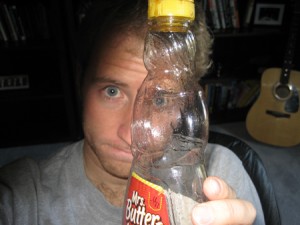
Where did Mrs. Butterworth’s boobs go?

When I was kid she was much shapelier. Now, she’s as flat as a pancake.

There are only two reasons why they could have disappeared (none of which is that she is old and gravity plays on such things – because Mrs. Butterworth is ageless):

1) Economics – Pinnacle Food Company, which produces Mrs. Butterworth, decided that they could make a greater profit if they flattened her out, thus robbing consumers of two D-cups of her sweet nectar.

2) Prudishness – After decades of children and adult alike fondling the syrup maven, our culture cannot handle inanimate objects with anatomy.

Banished by corporate greed or by our ultra-conservative culture, Mrs. Butterworth’s boobs are gone.

I miss them.

Now when I’m holding Mrs. B upside down, there is no matronly shelf to rest my index finger upon. Instead, my finger slides down her midriff and onto her hands clasped at her waist, as if to console her.

She’s the saint of syrup with her halo of dried mapley goodness just below her cap, but she’s also a woman. A woman robbed of her womanliness.

Shame on Pinnacle Foods. Shame on us all for sitting idly and allowing them to perform a double mastectomy on our momma of maple.

Add a Comment
Share This
Jun
9

Garment Workers asks: “Does the labor behind the label matter to you?”

By Rule29

I stumbled upon a profile of a woman in Bangladesh who has worked in and around the garment industry for decades. Today she works to give the workers a voice, help secure loans for and educate them.

When I was in Bangladesh I met some former-garment workers turned organizers. It’s right up there on the list of thankless jobs. In many cases, including this woman’s, the organizers have been blacklisted and couldn’t return to the industry if they wanted to.

How much to push before they price their industry out of work? But there is plenty of room for improvement in Bangladesh; wages there are some of the lowest in the world.

I also spent some time with the owners of the factories who are being squeezed pretty tight.  One factory owner said that he makes half as much now as he did five years ago.  There are more than a few players between the factory floor and the shopping rack. There’s the factory, the middle men, the middle men for the middle men, the buying houses, the brand, the store, and you and me.  As I say in the book: “Exploitation can occur on any level except one. The worker’s aren’t in a position to exploit anyone.”

The profile of this woman doesn’t really show all sides, but her story is powerful.

(I found this story via Ethical Style)

On entering the workforce at 12:

Akter had begun working when she was only 12. Her father, a construction contractor, had taken ill and was unable to work. “I was the eldest of four sisters and a brother. Schooling was the last thing on my mother’s mind. She wanted food to feed the family.” So Akter was forced to give up her education and instead accompany her mother to a garment factory.

On linking consumers and producers:

From consumers, Akter expects responsible shopping. According to her, consumers can play a huge role in transforming sweatshops into fair work places. She shares three pointers: “Before parting with your dollar demand for transparency from companies, provide information to the sellers about labour standards and make it clear to the shopkeeper that workers’ rights matter to you. That the labour behind the label matters to you.”

Add a Comment
Share This
Loading Quotes...
©2009–2012 Kelsey Timmerman
All Rights Reserved.
Contact Kelsey hi@kelseytimmerman.com

Bookmark the RSS feed
Sign Up for email updates